
 Posted by
What makes future leaders? “Well, authenticity eats authority for breakfast,” according to Dr. Kimo Quaintance, mentor and Chief Product Officer at ada, an EduTech company that offers a community-based learning and development program for organizations.
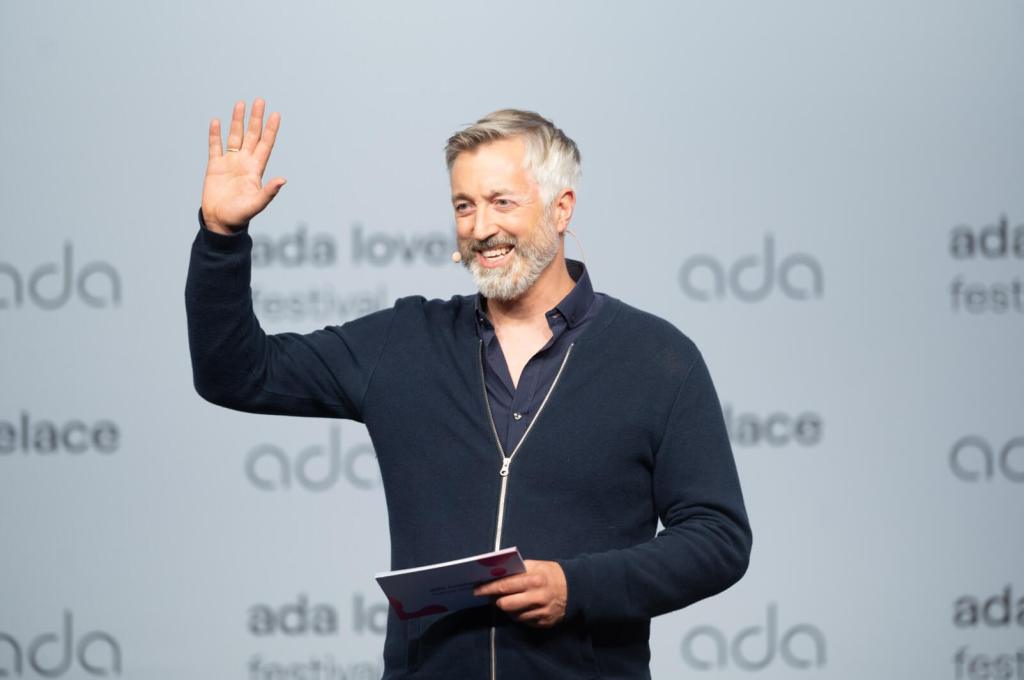
I met Kimo at the Ada Lovelace Festival—Europe’s premier conference on cutting-edge future topics— to talk about the essential qualities of managers in the unpredictable world and why some people still prefer the autocratic management style of Elon Musk.
Almost everything has been said about the competencies of future leaders. They should be ready to adapt quickly to new realities and be empathetic. They should think strategically, make data-driven decisions, build inclusive teams, and be able to manage conflicts. What further would you add to this list in 2023/2024?
Two things. First, the ability to listen deeply to others. The critical leadership skill of the future is the ability to listen deeply. It sounds simple, but many leaders aren’t skilled listeners, and it shows in the ways their teams and organizations are dysfunctional.
Giving someone else the experience of being seen and heard—and to reflect on what they have to say—is a foundational adaptive leadership quality. Good listening skills allow leaders to create buy-in for change, engage the collective intelligence of their people, increase reflective over-reactive decision-making, speed up decision adoption by building trust, and create psychological safety, which is the most critical differentiator between high and low-performing teams. Whenever I see those qualities lacking in an organization, it’s safe to assume that they probably suffer from poor listening skills at the leadership level.
Second, the ability to listen deeply to yourself. We live in a time of enormous pressure on individuals and uncertainty in our environments and organizations. It makes taking care of yourself as a leader incredibly difficult but also paramount because the only way to take care of other people and bring out the best in them is to first take care of yourself. Listening deeply to yourself means the ability to know when you need to rest, knowing your own resources for recovery and well-being, how to ‘de-stimulate’ yourself in a world of constant information flows and connectivity (yes, boredom is actually a skill now), and how to listen to and work with your own emotions. Taken together, these are pillars of the concept of conscious leadership.
What do good leaders do differently so that they manage to provide a healthy work-life balance for employees but still meet financial goals and consider ROI and KPIs?
I like to look at the data. For me, one of the most insightful feedback on that is McKinsey’s Organizational Health Index, which found that across nearly 100 different organizations on four different continents, out of a list of 20 different leadership attributes only four accounted for 89% of the difference in leadership effectiveness:
- Be supportive
- Operate with strong results orientation
- Seek different perspectives
- Solve problems effectively
To me, that’s strong evidence to support an argument that you not only can provide a healthy work-life balance while focusing on results but that to be effective as a leader, you must find a way to bring those two together. That balance of heart and results-oriented focus is more effective and enjoyable for most people than operating in just one extreme or the other.
Sounds good, but leaders are also humans, and combining hard and soft skills is incredibly challenging. The history of management is full of bad leaders who were successful and good leaders who brought companies into trouble. If there is no “one-fits-all” formula for outstanding leadership, how should managers know how to manage people?
The essence of being a good manager is making it easier for employees to do their jobs well. Now, that clearly means you’ve got to be working with good employees to start with—but assuming you are—we have good data from studies like Google’s Project Oxygen about what makes for a good manager. This study of thousands of teams across Google aimed to identify essential qualities of effective managers within the company, leading to the creation of a set of management principles to improve team performance across the organization.
One of their key findings was that possessing technical skills or deep area knowledge is relatively insignificant to creating positive team outcomes compared to skills like being a good coach, not micromanaging, showing interest in employee well-being, listening to the team, and helping employees with career development.
The most interesting part of this study was that Google then introduced these skills and saw statistically significant improvements in team outcomes because of the targeted training. So even though we’re not all Google, you can’t really go wrong investing in these skills because they reliably generate positive results.

As a leader, allow yourself to ask questions. The widespread idea that one needs to know everything immediately is anything but constructive. It is way more helpful, trustworthy, and convincing to say from time to time that you have not figured something out, but you’re working on it—instead of pretending to have the right solution all the time.
—Prof. Dr. Miriam Meckel, Co-Funder and CEO of ada.
When you list qualities like “being a good coach” or “listening to the team,” I ask myself why so many people prefer bosses like Elon Musk, who choose power over empathy.
Brilliant narcissists who compensate for their fear of emotional closeness with grandiosity can be quite attractive as leaders.
Most people like leaders who exude confidence, can clearly articulate powerful visions of the future, and get results. Most people want to be part of building something meaningful and want to be part of something bigger than themselves. Elon Musk embodies many of these qualities, at least on a surface level, but I don’t think that’s necessarily made him a boss that people actually prefer to work for.
These kinds of incredibly unbalanced leaders often get a lot done but also tend to leave a trail of destruction behind them, as many of the people who have worked closely with Elon Musk report. And then, of course, many people just like to fantasize about a charismatic leader coming to save them because they’re not ready or willing to take responsibility for the changes they want to see in the world.
We see this in all of the autocratic movements that pop up in a world where more and more people feel confused and powerless in the face of change.
OK, some employees might prefer the authoritarian style of Elon Musk, while some expect the inclusive and empathetic approach of Jacinda Ardern. How should leaders lead when group members are diverse?
In some ways, I would argue that this is another way of talking about archetypal energies that everyone possesses. Different situations are going to call for different expressions of our personality, like fierceness, empathy, playfulness, intellect, or wisdom—this is why diversity in groups is just as valuable as the diversity in ourselves, as long as we learn how to tune into what is needed in each moment because that is constantly changing.
In the years I’ve spent in personal development, and especially through men’s work, I’ve come to believe that simply being yourself is not just the easiest way to lead; it’s also the only one that works.
That’s not to say we don’t need role models. You just have to know that you’re working with projections when you do that. We’re all repulsed by the qualities in others that we reject in ourselves—our shadows—and we admire the qualities in others that we already possess (our gold). Learning the art of your own leadership style is mostly a game of learning how to work with your shadows and your gold, and looking at positive and negative role models helps navigate all of that.
As a CEO, it is imperative to instill trust within teams, fostering their confidence and granting them greater autonomy in decision-making, even when it entails making mistakes along the way. A successful leader must also be attuned to signals originating from a variety of sources and ecosystems, embracing diversity as a core value. This involves the skill of bringing all voices to the table, cultivating teams with diverse perspectives capable of constructively challenging the leader. Leaders must encourage a sense of acceptance that permits experimentation and acknowledges that making mistakes is a natural part of the growth process—notes from the Ada Festival 2023.
Let’s take a short break. Can you please list the competencies of the leaders of the… past? Why are these features not relevant anymore?
I don’t think I can do it because a lot of what makes good leaders hasn’t changed much in the thousands of years we’ve been documenting leadership.
That’s why reading history and classical literature is still so valuable. The classics have stood the test of time because they possess wisdom about the nature of the human operating system, which hasn’t changed much in recorded history and won’t likely change much in the foreseeable future.
For a number of reasons, the environment in which we operate has become more unpredictable—the so-called VUCA world (VUCA stands for volatility, uncertainty, complexity, and ambiguity. It describes the situation of constant change). That has made the learning and growth mindsets relatively more valuable than control and fixed mindsets for organizations to foster, at least when agility is required. A growth mindset is also what happens to be far more satisfying for most people to possess because it leads to development and opportunity-seeking behaviors rather than just safety-seeking ones.
Let’s elaborate on the constant change you mentioned. Don’t you think that—except for a small group of innovators, statistically 3% of society—people are tired of change because there is too much of it right now?
People are tired of constant change when there are no opportunities to rest and integrate change. It’s why one of the critical adaptive leadership skills is to know when to “turn up the heat” and push people to produce results or execute changes and when to “turn down the heat” to let people rest and integrate after periods of change.
It’s the same in all relationships. If you never change, the relationship stagnates and dies. If you never rest and integrate after changes, you will burn out, and the relationship also dies. It’s all about understanding the cyclical and rhythmic nature of life and working in tune with that rather than against it.

Can you share examples of organizations or leaders already embodying the principles of future leadership? What makes them stand out?
In the non-profit sector, I deeply admire the work of Rick Doblin, who founded the Multidisciplinary Association for Psychedelic Studies, which is leading nothing short of a revolution in the way mental health and trauma are treated around the world. Rick stands out because of the clarity of his vision, his deep understanding of how to turn massive social and political resistance into forces that support his vision, his ability to bring both ego and humility to work, and his capacity to bring so many different voices into the same room to work towards a common goal.
Almost every year, new trends emerge in leadership of the future. Is it still possible to keep up with them all?
I don’t follow yearly trends in leadership, but I like to look at larger trends that emerge over decades.
One of the most important seems to be the desire for emotional intelligence, intimacy, and honesty that so many people are craving from their relationships with each other at work and, thus, from their leaders.
That simply wasn’t a cultural reality, say, 50 years ago.
As for why, it reminds me of a question I heard once from a biologist: Why did humans grow eyes? Well, at some point, we wanted to see our world. It helped us survive and thrive. Leadership megatrends are in some way a response to these social evolutionary pressures, and following them is something like a preview of where humanity is going on a larger scale. There’s a big movement in society towards personal growth, transformation, and more personal authenticity. That desire can’t be separated into work life and personal life. Growing as a person is the same thing as growing as a leader, and we are bound by duty as leaders to explore this in ourselves and support it in the people we lead. It’s part of what makes leadership deeply satisfying and fascinating work for me.
We are at the Ada Lovelace Festival in Berlin, where leadership-related topics are at the center of almost all discussions. Could you please summarize your five takeaways regarding organizational transformation?
Here you go:
- Real growth happens in connection with other people.
- Connection is better than perfection.
- Authenticity eats authority for breakfast.
- A learning mindset beats a control mindset.
- Don’t forget to play. It’s the only thing that’s going to keep us all sane in the long run.
Thank you for your time, Kimo.
In the future, work will revolve around human-centered values, amplified by technology that unlocks our creative potential. Cutting-edge innovations will create a workspace that truly caters to human needs – AI will be central in taking over administrative and repetitive tasks that diminish job satisfaction. Work and life will be seamlessly blended into just life. This transformation also calls for a shift in leadership, moving from pure management to a coaching role characterized by empathy and the promotion of an inclusive culture. People must feel like integral components of the organization, rather than mere workers—notes from the Ada Festival 2023.

Can I ask you a favor?
Please donate to aboutDigitalHealth.com (€1+) and support independent (and still human) journalism. Thank you for your support!
€1.00
 about Digital Health