
 Posted by
Big tech companies step into the role of “shadow care providers,” blurring the line between well-being and medicine, while data-driven consumer health solutions are now more trusted and accessible than a traditional doctor’s visit. What’s called “digital transformation” is, in fact, a historic shift in power within the healthcare industry.
The brand new, two-system healthcare
Healthcare is one of the most rapidly evolving industries, driven by the ongoing revolution in knowledge and technology. Just as the invention of the stethoscope, antibiotics, and X-rays once transformed medicine, we are now witnessing a new wave of disruption. For the first time, the technology empowers individuals more than healthcare professionals.
Digital transformation is not new, but for the first time, it is being driven by powerful new forces: advanced communication technologies, big data, and artificial intelligence. These technologies are now widely adopted globally, creating a parallel model of healthcare that exists outside traditional systems and is led by technology companies with no historical connection to the medical field.
AI, smartwatches, and health apps are no longer mere “add-ons” to the healthcare experience. They are becoming the backbone of a fast-growing alternative, direct-to-patient healthcare system. Patients, frustrated with long appointment wait times, a system that often focuses on treating symptoms rather than promoting holistic care and prevention, and a rising gap between the digital world and outdated care are increasingly turning to new, tech-driven solutions.
The healthcare system failed to offer a digital experience. Even patient portals or electronic health records available failed, as they provide access to data but no actionable insights.
As a result, we are seeing a division in healthcare into two-level care:
- System 2: Traditional medicine delivered in hospitals, clinics, and doctors’ offices.
- System 1: Digital well-being services that are starting to resemble medical care.
Following Daniel Kahneman’s theory of decision-making, System 2 represents “slow” healthcare, offered by healthcare institutions, which is regulated and thus static: deliberate, institutional, and procedural. In contrast, System 1 is “fast” medicine: immediate, user-driven decisions based on data from digital devices, wearables, online platforms, and apps.
Believing that digital transformation benefits both patients and the healthcare system is an illusion. Since the advent of the first smartphones, individuals have rapidly adopted technology that makes their lives easier. Meanwhile, institutions – stuck in old cultures and regulatory frameworks – remain static, strongly influenced by the interests of stakeholders, from health insurers to the pharmaceutical industry.
Generative AI and the rise of AI agents will likely accelerate the growth of this gap.
System 1 is taking over because System 2 is breaking down
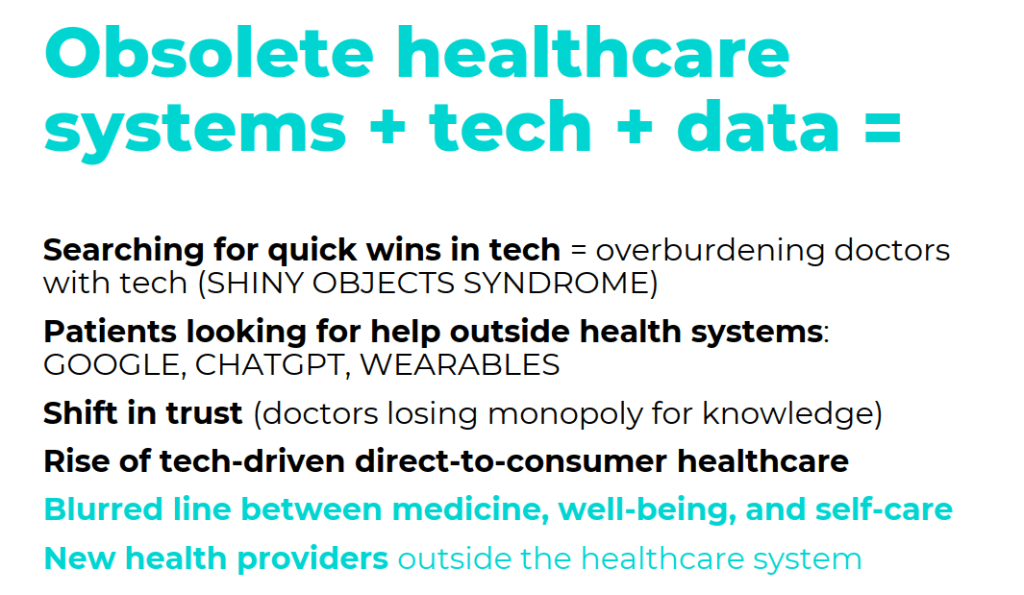
Patients are not waiting for healthcare systems to catch up; they’re seeking out the benefits of this technological shift themselves. This is especially true for Generation Z, raised on social media and e-services, who expect the same seamless experiences from healthcare as they do from other industries.
Today, large language models handle millions of health-related questions daily. We turn less to “Dr. Google”. We now consult “Prof. ChatGPT” about symptoms, diets, mental health, sleep, and fitness. ChatGPT receives 2.5 billion prompts daily from people requesting text summaries, graphics, or emails. OpenAI is well on its way to dethroning Google with 8.5 billion queries per day.
ChatGPT has another advantage over Google: it offers a human-level experience of communication, regardless of whether the empathy of AI is merely simulated. A recent Harvard Business Review report found that “mental support” is the top reason people turn to AI for health-related inquiries. These tools are always available, easy to use, and offer something traditional healthcare often cannot: instant, nonjudgmental answers, without the time limits of a 10-minute consultation.
New AI systems are also demonstrating increasingly accurate diagnostic capabilities. For example, Microsoft’s MAI-DxO can diagnose diseases four times more accurately than experienced doctors, often with fewer tests, less time, and at a cheaper price. MAI-DxO simulates a doctor’s reasoning, asking follow-up questions, analyzing available data, and adjusting its conclusions in real time.
Social media and the rise of consumer healthcare
Social media platforms are amplifying this trend, turning healthcare into a “one provider – millions of consumers” model. On platforms like TikTok and Instagram, it’s not doctors, but influencers who are shaping health behaviors, telling people what to eat, how to self-diagnose, and how to live longer. Videos about ADHD and longevity hacks receive billions of views because they offer simple, relatable solutions delivered by charismatic figures.
Unfortunately, much of this content is misleading, and some of it is outright dangerous. However, algorithms reward content that is engaging, rather than necessarily accurate. Short, emotional, and entertaining clips are pushed to the top, while boring evidence-based knowledge that doesn’t spark debates is neglected by algorithms designed to draw out attention.
Social media has taken over health education, and the full consequences can be disastrous.
Meanwhile, health is becoming a symbol of status in developed societies. Maintaining good health is often viewed as a measure of personal success. It’s no longer just about following medical advice; it’s about being savvy, independent, and even skeptical of traditional medicine. This has fueled the booming popularity of dietary supplements, drugs like Ozempic for weight loss, and soon, personalized AI agents.
2026: AI agents begin seeing their first patients
Wearable technologies track sleep, stress, heart rate, and early signs of illness. The latest smartwatches can perform ECGs, monitor movement patterns, and even detect chronic diseases. Smart rings and jewelry collect data to help individuals optimize their lifestyle choices. It’s only a matter of time before devices like the Apple Watch or Samsung’s wearables offer non-invasive glucose monitoring.
But it is not only digital medical services that are loved by patients. Neko Health, a preventive care clinic launched by Spotify’s founder, is an example of an innovative approach to health, filling the gap in the market. With locations in London and Stockholm, Neko Health offers full-body scans analyzed by AI for just $299. Doctors then review the data to identify potential health risks or early-stage diseases. Demand is overwhelming – the London clinic has a waitlist of over 100,000 people, despite criticism for an approach that does not guarantee the absence of illnesses (false negative results) and may only lead to over-testing. It doesn’t matter – patients want to make sure everything is okay with their health and gain psychological comfort.
Technology companies are now becoming leaders in preventive healthcare, leveraging real-time access to user data. Traditional providers are gradually losing their exclusive grip on care, and the boundary between regulated medical services and general “wellness” offerings is blurring.
While many patients are pleased with instant access to health insights and recommendations, a critical problem remains: digital care lacks precision. Data from non-medical devices, such as smartwatches, can be misleading. But for patients, what matters most is the feeling of control. They want to hear what’s wrong, and doctors are no longer the only authorities we refer to. We start trusting in machines, which has long been recognized as a psychological phenomenon known as anthropomorphism.
All this, even though data can’t tell the whole story of our health.
We are entering the next phase of healthcare consumerism. AI agents are poised to become active participants in healthcare, not just tools that passively analyze data. These agents can coordinate care, monitor progress, and even manage treatment plans. They serve as digital companions, providing support to patients around the clock.
Unlike traditional algorithms, AI agents can make decisions autonomously. And they will have synthetic emotions, offering non-stop help, exhaustive knowledge when we need it, comforting words when we are upset, and understanding when we need it most, even in the middle of the night.
AI is impressive and overhyped
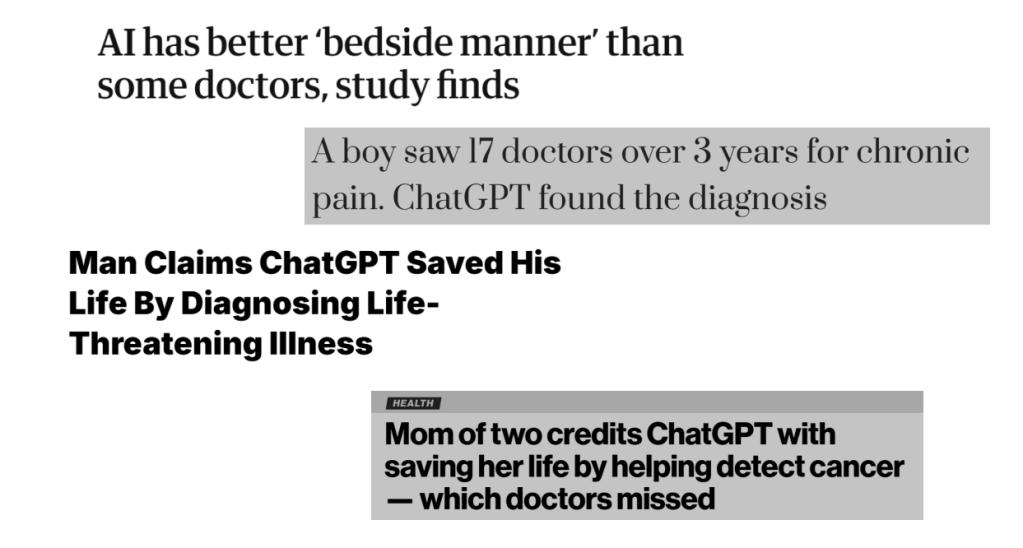
AI is making its way into both System 1 (consumer health) and System 2 (clinical care). Many applications offer real hope, especially in reducing administrative burdens. AI can scan electronic medical records to predict disease, extract relevant information, and even document doctor-patient interactions automatically.
AI also enhances clinical decisions by cross-referencing patient data with the latest research, enabling more personalized and evidence-based treatments. But despite rapid progress, AI is not a silver bullet for the healthcare system’s challenges.
We are currently in a phase of AI euphoria, with overly optimistic headlines and speculative promises. While large language models may soon diagnose with precision, reducing medical errors, issues such as hallucinations and a lack of clinical certification remain major hurdles.
Another critical barrier is data quality. AI requires clean, reliable information, and most healthcare systems still lack the necessary infrastructure for this.
Democratization of healthcare? Rather commercialization
This moment marks more than a technological upgrade. It’s a transformation of healthcare’s very foundations. We are shifting from the long-standing model of “one doctor, one patient” to “one AI agent, millions of users.” From treating the patient in a clinic to managing their data in the cloud. From scheduled visits to on-demand, 24/7 support.
Traditional medicine is far from obsolete. Regulations still protect its authority, especially in complex or surgical cases. Clinics will remain crowded. However, the way patients perceive and interact with healthcare is undergoing a fundamental change.
A new era is emerging, where big tech companies are taking on a central role in global healthcare, competing for a market projected to exceed $21 trillion.
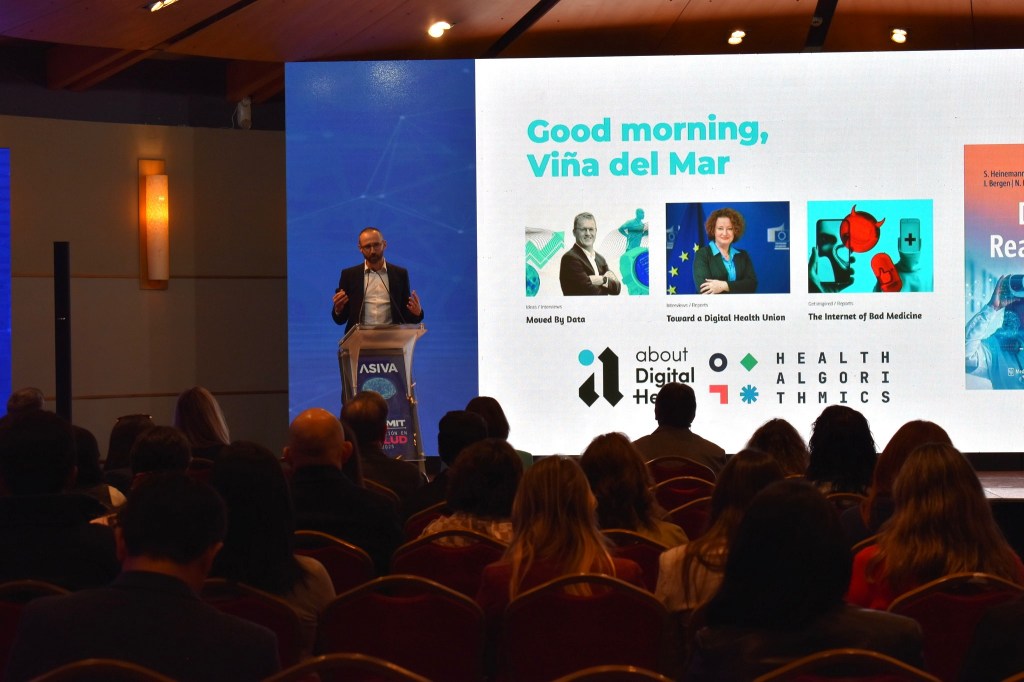
Note: This article is based on my keynote at the ASIVA Health Innovation Summit 2025 in Viña del Mar, Chile. Interested in booking a keynote on digital transformation in healthcare? Feel free to contact me.
Can I ask you a favor?
Donate to aboutDigitalHealth.com and help sustain this not-for-profit knowledge portal. Every contribution makes a difference. Thank you!
€1.00
