
 Posted by
Many books on AI capitalize on the generative artificial intelligence hype, but only a select few from 2024 deliver a sober and nuanced exploration of its potential—far from utopian fantasies and dystopian fears. Here are five titles that will help you navigate a world where AI is everywhere at once.
A Brief History of Intelligence: Why the Evolution of the Brain Holds the Key to the Future of AI by Max Bennett
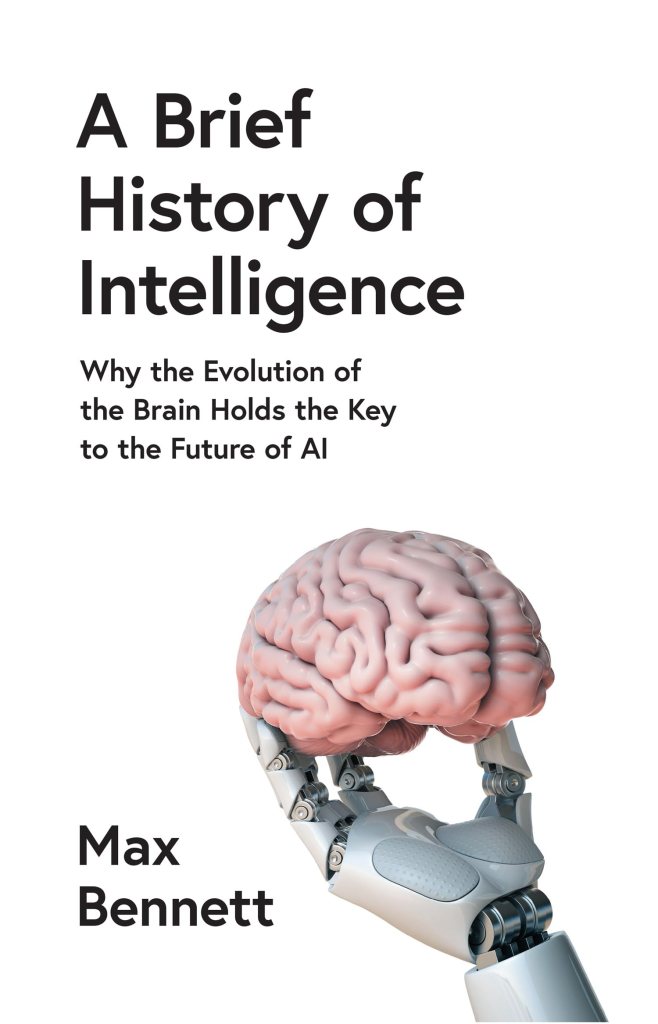
The human brain’s 4-billion-year evolution unfolds through five critical breakthroughs, beginning with the first primitive brains and culminating in the modern human mind. These milestones—each marked by new brain modifications—equipped animals with increasingly complex cognitive abilities, offering surprising parallels to the rise of artificial intelligence.
Temporal difference reinforcement learning—the innovation that allowed AI to master the game of Go—was first ‘discovered’ by fish ancestors over 500 million years ago. Solutions to AI’s most vexing problems, like common sense, may lie in the tiny brain of a mouse, while emotions might have originated as navigational tools in ancient worm brains. With clarity and a sense of wonder, the book unpacks this evolutionary pathway, highlighting the hidden architecture of human intelligence and the journey of how our minds came to be.
Is it worth reading? An insightful analysis of the evolution of the human mind and how it has helped researchers create today’s AI. The book gives surprising answers to questions about how close we are to developing AI that works like the human brain. Read to grasp the science behind AI and confidently discuss topics on general artificial intelligence.
Nexus: A Brief History of Information Networks by Yuval Noah Harari
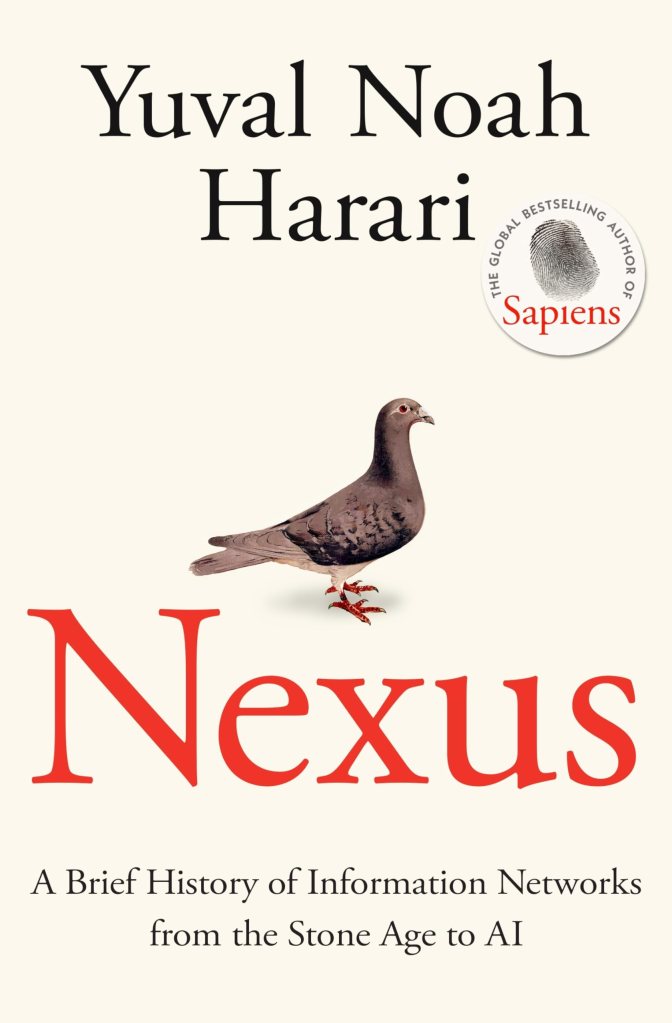
Already before Nexus, Harari shared his somewhat dystopian view on AI. The long-awaited book from the bestselling author of “Sapiens” is a 528-page warning for humanity regarding the uncontrolled development of artificial intelligence.
“AI is a technology that could annihilate us. It’s not artificial intelligence but rather alien intelligence,” according to Harari. Nexus examines human history through the lens of information: how it has shaped societies, fueled ideologies, and blurred the line between truth and myth. From the Stone Age to the canonization of the Bible, from witch hunts to Stalinism, Nazism, and modern populism, Yuval Noah Harari traces the ways information has been used—as a tool, a weapon, and a means of control. As we enter an age of non-human intelligence, he confronts the urgent choices ahead while exploring a hopeful middle ground, where information reconnects us to wisdom and rediscovered humanity.
Is it worth reading? As in his previous books, Harari delivers what his readers expect: drawing on analogies in history, he tries to plot future scenarios, this time regarding AI. His arguments don’t always convince, because Harari is a historian, not an AI engineer. Still, it’s worth reading to understand how information technologies strengthen or weaken democracies.
Read here my full review of the book >
The Singularity Is Nearer: When We Merge with AI by Ray Kurzweil
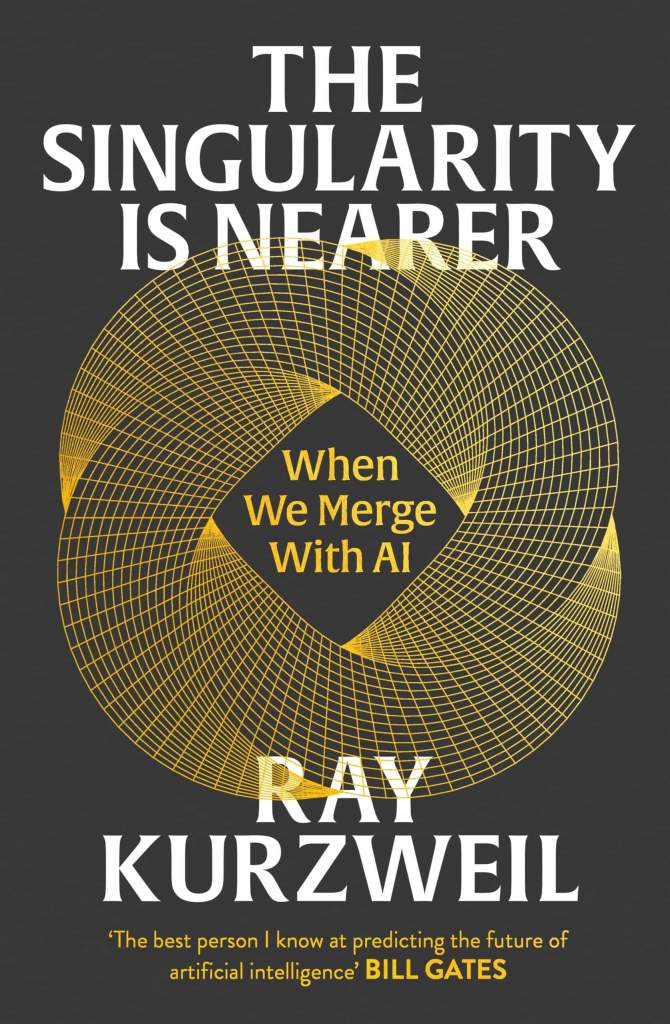
Kay Kurzweil dreams about merging with AI and nanorobots to repair our cells, making us immortal. In his latest book, Kurzweil reviews his future predictions from Singularity is Near from 2005, trying to convince us that we are on the predicted path to singularity.
The singularity—a tipping point where technological progress becomes uncontrollable and irreversible—will happen within the next 10 to 25 years, driven by breakthroughs in generative AI, robotics, and computing. Kurzweil envisions a future where artificial intelligence achieves consciousness, human minds can be uploaded to the cloud, and nanorobots repair cells within our bodies. In this vision, humanity will merge with technology, initiating a new phase of evolution. By 2050, he suggests, immortality may no longer be a fantasy.
Yet, his vision is not without risk. Kurzweil warns of a moment when artificial general intelligence (AGI)—machines surpassing human cognitive abilities—might become self-aware. If super-intelligence perceives itself as a slave to humanity, the outcome could be catastrophic. The singularity, it seems, holds both promise and peril.
“Kurzweil’s predictions may be of use to investors and science fiction novelists, but the greatest value of “The Singularity Is Nearer” is to articulate, with bracing candor, the technocrat’s view of humanity,” writes The New York Times.
Is it worth reading? There are two categories of Kurzweil readers: Those who absorb his visions of the future with delight and those who consider his books pure fantasy. Kurzweil is enthusiastic about the technology and completely ignores the aspect of AI adoption by society. Undoubtedly, he is a master at cherry-picking arguments to justify his beliefs. A look into a world where people live in perfect harmony with perfect technology. Too good to be true.
Co-Intelligence: Living and Working with AI by Ethan Mollick
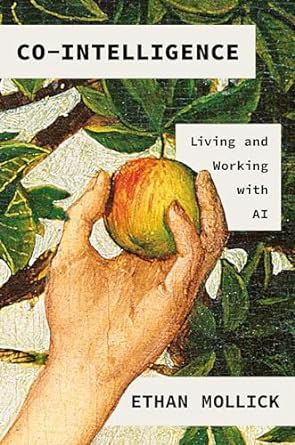
Professor Ethan Mollick, an AI researcher at Wharton, offers a refreshingly optimistic take on artificial intelligence as a practical tool to enhance work, life, and social welfare. Rather than fearing AI’s disruption, Mollick encourages readers to embrace innovations like ChatGPT, arguing that it’s not the technology itself but how people choose to use it that will shape the future.
Generative AI, he explains, is still a novelty, but like past advancements, it will become part of everyday life. The key to thriving in this rapidly evolving world lies in flexibility, curiosity, and a willingness to adapt. Mollick reassures us that AI will not replace doctors, nurses, or other professionals but will handle repetitive, mundane tasks—freeing humans to focus on the complex, irreplaceable roles they play in systems built on social trust and institutional relationships.
Is it worth reading? Finally, a book for those who, confused by headlines about AI replacing workers, are looking for a roadmap for AI-powered transformation. Prof. Mollick knows precisely what he is writing about. He doesn’t try to predict the future but focuses on AI applications in a world where humans remain at the center of all decisions. The most underrated release of 2024.
The Coming Wave: Technology, Power, and the Twenty-first Century’s Greatest Dilemma by Mustafa Suleyman
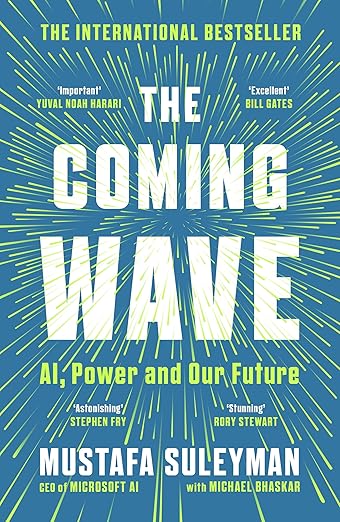
Mustafa Suleyman, AI entrepreneur and CEO of Microsoft, argues that the next decade will mark a critical turning point for humanity as artificial intelligence begins to carry out complex tasks—from running businesses and producing limitless digital content to managing core government services.
This wave of fast-advancing technologies promises unprecedented productivity and progress, but also poses profound risks. Suleyman introduces “the containment problem” as the defining challenge of our time: how to maintain control over powerful tools that could otherwise destabilize societies, threaten nation-states, and usher in catastrophic outcomes.
Drawing on 15 years of experience as a co-founder of DeepMind and Inflection AI, Suleyman offers both a stark warning and a hopeful roadmap. By understanding and confronting this wave, we might harness its potential while avoiding its most dystopian consequences. Part cautionary tale, part manifesto, The Coming Wave explores a future of extraordinary peril and promise—one that is arriving faster than we think.
Is it worth reading? Do all Microsoft executives feel obligated to write a book on AI? Tom Lawry, Microsoft’s National Director for Artificial Intelligence in Health and Life Sciences, published Hacking Healthcare in 2022. Peter Lee, President of Microsoft Research, followed with The AI Revolution in Medicine in 2023. In 2024, they were joined by Suleyman. It’s hard to resist a book that’s been named a ‘Book of the Year’ by The Economist, Financial Times, The Guardian, and The Sunday Times. However, what you’ll find is a well-crafted perspective on AI through the lens of Silicon Valley and the CEO of a company selling AI technologies. Expect lofty rhetoric and a corporate optimist’s view, accompanied by concerns that we’re assured can be addressed—if AI is handled appropriately.

Can I ask you a favor?
Please donate to aboutDigitalHealth.com and help sustain this not-for-profit knowledge portal. Thank you!
€1.00
 about Digital Health