
 Posted by
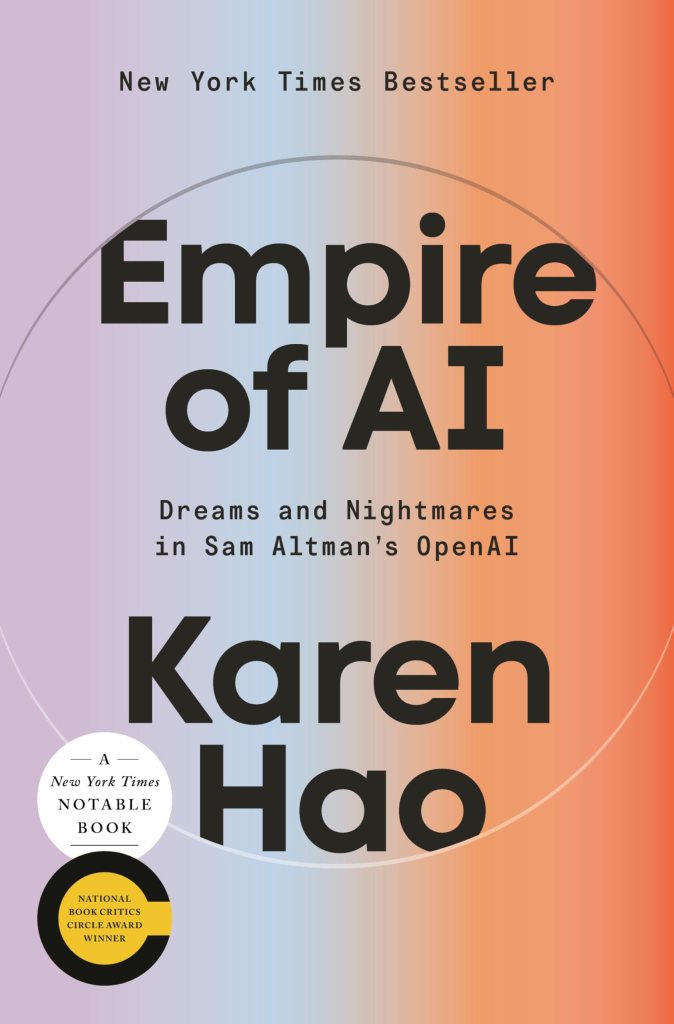
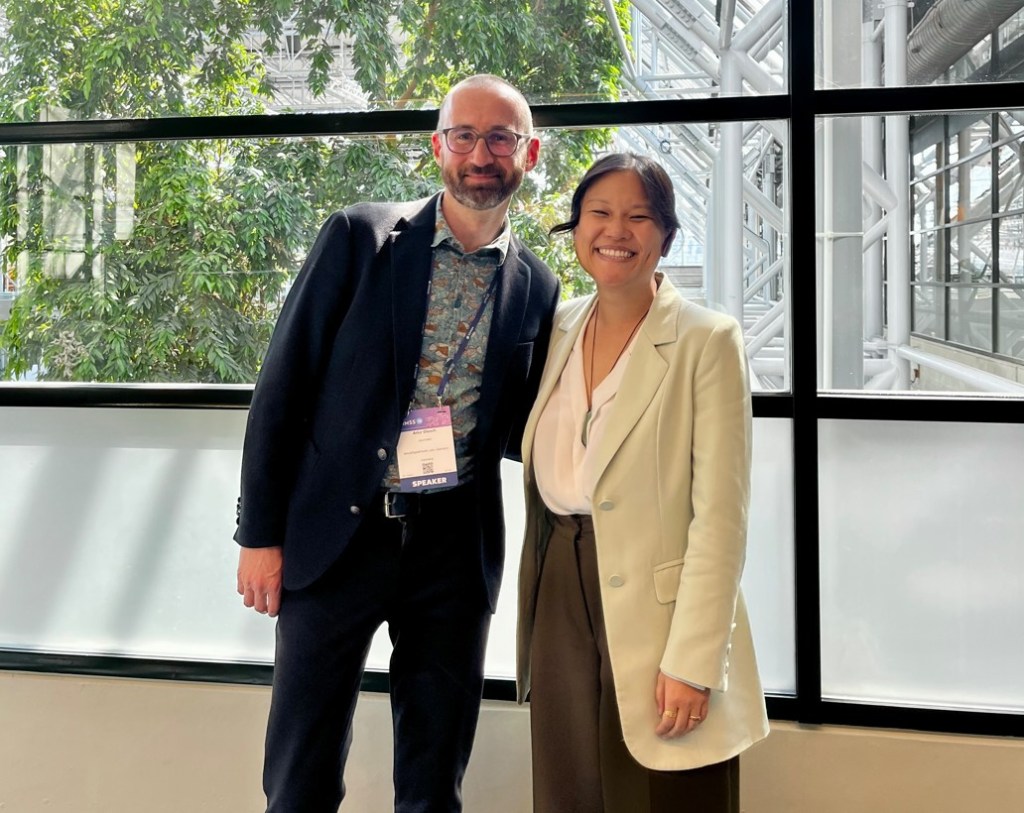
“The AI industry’s obsession with building ever-larger models has become an end in itself. And it’s destructive,” says Karen Hao, author of Empire of AI. I met her in Copenhagen to discuss the race for more data, more compute, and more power, and why she believes healthcare is becoming a key battleground for AI companies.
My personal takeaway after reading The Empire of AI was that large AI companies are becoming new power centers with enormous influence over society. The problem is that the AI they develop can threaten societies and even democracy itself. Is more regulation the only way to avoid this dystopian scenario?
I would say more targeted regulation, and also a broader understanding of what constitutes AI governance. I don’t think governance comes only from governments. If we assume governments alone are responsible for containing these companies, it’s simply not going to work, because accountability has to come from all sectors of society. Journalists need to be thinking about these issues. Healthcare institutions need to be thinking about them. Communities, parents, teachers, educators, everyone.
Every sector and every individual should feel they have agency in shaping this technology. But yes, of course, governments carry a particularly important responsibility because they can compel companies to act in the public interest rather than according to pure market logic.
One of the key things governments need to do right now is demand far more transparency from these companies. At the moment, we don’t really know what data they train on, where they build their computational infrastructure, how their systems affect people’s health, or what kind of data, including health data, they may be collecting from users.
All of this needs to be brought into the open so that people and different stakeholders can make informed decisions about how they engage with these technologies, and also challenge these companies when they disagree with the way they operate.
While reading your book, I kept thinking about one thing. During your work on Empire of AI, you conducted extensive research and spoke with insiders. Did you know from the very beginning that you would end up writing a book about the darker side of AI companies?
When I started writing the book, I knew it was going to be critical. But I actually started reporting on AI back in 2018, and at that point, no, I didn’t know that this was the direction the work would take.
The more I followed the story, however, the more it naturally guided me there, because that was the reality unfolding in front of me. There were enormous power imbalances between the people developing these technologies and the people affected by them, and many of those affected were being harmed.
So I started focusing on documenting those stories because very few people were doing that work.
Based on the insights you uncovered, could you also write a book about the good intentions of the AI industry?
I don’t think that would be particularly productive at this moment, because there’s already an overabundance of books focused on exactly that. Many of them are not grounded in real case studies. They mostly speak in hypotheticals about AI’s future potential.
As a journalist, I focus on what is actually happening right now.
Your book focuses heavily on OpenAI, while Anthropic is often portrayed as a more ethical alternative. We remember the controversy around the Pentagon deal, for example, and Anthropic’s decision to delay the release of its most powerful model, Mythos. Are there ethical AI companies at all?
Yes, but not the ones pursuing the approach I criticize in the book, which is this “scale at all costs” model of AI development.
Anthropic is not ethical simply because it also follows the same underlying logic. All the additional safeguards and branding elements they attach to their models to project the image of being more ethical do not actually address the root harms these systems are causing in society.
However, there are other AI companies that do not follow this model. For example, Hugging Face is an open-source AI company that I think is doing genuinely valuable work in strengthening the open-source AI community and supporting scientific research on these models.
Unfortunately, many of the companies pursuing fundamentally different or more novel approaches are underfunded precisely because so much investment is concentrated around the scaling AI labs.
We are in the middle of an AI race between the US and China, and AI is an extremely fast-moving technology. It almost feels as if companies have to play unfairly to win. Moving fast and leaving ethical dilemmas behind seems almost part of the game. Am I wrong, or do you think there is something to that?
The problem with that logic is that it assumes these companies are actually representatives of the United States or China. I don’t see it that way at all. I would not consider companies based on US soil to be “American” in any meaningful sense of the word. They do not represent American interests. They do not serve the American people. In fact, Americans are among the people most exploited and extracted from by these companies.
So what exactly are they racing for? They are racing for their own dominance. They are not competing on behalf of their countries. Do they use China as a kind of bogeyman in order to justify being allowed to devastate the environment, undermine human rights, and erode the rights of Americans themselves? Absolutely.
But people need to open their eyes and recognize what is really happening. These companies are manufacturing the idea of a race to convince the public and governments to give them a license to do whatever they want and continue expanding their empires.
That leads directly to my next question. Do people actually care whether AI is ethical, or do the benefits of using AI outweigh the questionable practices inside these companies? In other words, will the invisible hand of the market eventually eliminate unethical AI companies because of reputational damage, or is ethics simply not that important to end users?
I think it is hugely important to end consumers.
But often people either don’t realize they can have the benefits of AI without accepting all of these costs, or they simply don’t know what alternatives exist.
We’ve seen industries confront this kind of problem many times before. Take the fashion industry. It was associated with severe environmental destruction and terrible labor practices. But because of consumer outrage, government regulation, and coalitions working together around the world, entirely new markets emerged for sustainable fashion and human rights-centered fashion brands.
Today, there is a very robust market for those products. Consumers are willing to pay a premium for them, and that pressure forced other companies to improve their own practices and establish a minimum standard for acceptable behavior.
I think the AI industry will eventually have to evolve in the same way.
There will absolutely be consumer backlash. In fact, there already is backlash against the unethical practices of these companies, and that backlash creates space for alternatives to emerge.
Those alternatives will be developed, and people will begin voting with their feet. But these transitions take time. One reason we haven’t yet seen a larger shift in consumer behavior is simply that many of those alternatives still do not fully exist.
How do you see the role of Europe in this AI landscape?
In an ideal world, Europe would hold firmly to its convictions and continue enforcing the laws it has already put in place. Unfortunately, there have been many recent headlines suggesting that the European Commission is considering watering down numerous regulations.
For our reads: The European Commission is working on the Digital Omnibus deal to simplify AI rules.
But honestly, even simply enforcing the rules that already exist would go a long way toward containing the influence of these companies. If the EU can also compel companies to provide much greater transparency across the AI development supply chain, that would create another important layer of accountability. It would give different sectors of society and individual citizens the information they need to evaluate and, when necessary, challenge these companies.
At the same time, Europe should be investing far more heavily in fundamental AI research and in AI applications that actually address real societal problems.
Right now, I think it’s an extraordinary misallocation of society’s resources to funnel so much money, land, energy, and water into consumer chatbots. We should instead be developing specialized AI systems that accelerate drug discovery, improve healthcare outcomes, and tackle the kinds of problems these companies constantly claim they want to solve but rarely make meaningful progress toward.
That kind of innovation will require public funding and political direction. Governments need to steer research toward the public interest, not just market interests, and help stimulate the kinds of breakthroughs that can deliver long-term social value.
Let’s talk about healthcare. OpenAI launched GPT for Health and GPT for Clinicians this year. Do you think these initiatives reflect a broader healthcare strategy at OpenAI?
I don’t think so.
My sense is that one reason OpenAI rolled these products out is that healthcare data remains one of the last major “walled gardens” these companies still struggle to access. In the United States, healthcare data is one of the few large data pools that is actually regulated under HIPAA.
But if companies can persuade consumers or clinicians to directly use these tools, then users are effectively handing over their own data voluntarily through consent embedded in the terms-of-service agreements. In that sense, the companies are finally able to break through that wall by going directly to patients and clinicians themselves.
The second reason is that AI companies have been facing growing criticism for failing to meaningfully engage with the societal challenges they have long promised to solve, whether that’s healthcare, climate change, or other major global issues.
So these initiatives serve a dual purpose. On the one hand, they allow companies to data-grab in areas they traditionally could not easily access. On the other hand, they function as a form of virtue signaling, allowing companies to claim they are finally moving in the directions they always said they would.

Millions of people are already using GPT for Health, and every time something goes wrong, including reported suicide cases, the company responds that it’s not their responsibility but rather the user’s fault for using the tool incorrectly. Is this a typical OpenAI strategy when facing backlash?
Yes. This is a pretty canonical Silicon Valley playbook.
Mark Zuckerberg used the exact same argument when Meta was accused of contributing to severe mental health harms among teenagers. The response was essentially: “It’s not our algorithms or platform design, it’s just users spreading harmful content.”
And of course, we now have court rulings that, in the eyes of the law, concluded that the design of those platforms itself played a central role.
In the same way, OpenAI is now using a very similar playbook, attempting to abdicate responsibility and arguing once again that users are the problem. Hopefully, we will soon see a similar legal and public reckoning around these AI platforms, much like we eventually saw with social media, and hopefully much faster than it took society to respond to social media harms.
Do you personally use generative AI chatbots for health-related questions?
I don’t use generative AI chatbots for health-related questions at all.
Do you plan to?
Absolutely not.
Empire of AI was published in 2025. What has happened since then regarding the growing dangers of AI?
What we are seeing now is the fusion of Silicon Valley and Washington.
I finished the manuscript before Donald Trump was reelected, and since then we’ve seen the rise of what I consider a deeply disturbing alliance between the state and the tech industry.
This connects directly to healthcare, but also to many other domains. The use of these technologies in warfare, for example, in military operations against Iran, is killing people, devastating the environment, and creating public health crises on an almost unimaginable scale.
And honestly, I think this is the logical conclusion of how these companies have always operated.
These are empires. They have imperial ambitions. They will align themselves with whichever political actors can provide them with more fuel to accelerate those ambitions.
At the same time, the Trump administration has made it very clear that it wants to rebuild American imperial power. In that sense, the administration and these companies become highly complementary allies, willing to engage in extremely destructive partnerships.
You already mentioned many negative aspects of AI, but what makes you personally most angry about AI development, both in healthcare and beyond?
What makes me angry is that these companies are not actually trying to improve people’s health.
They are taking something that is universally compelling. Everyone wants good health. Everyone wants their parents to stay healthy. Everyone wants their children to be healthy. They are exploiting something deeply human and universal, along with our vulnerabilities and fears around health, in order to sell products that often do not work.
At the same time, they are extracting the most intimate data from our lives and using it to build enormous power structures that ultimately undermine democracy itself.
I find that deeply exploitative, manipulative, and immoral.

Is there anything that gives you hope?
Absolutely.
I think these companies are already beginning to show significant cracks in their ability to sustain what they are doing.
First of all, many of them still do not have viable business models. Second, they have generated enormous public backlash around the world, especially in the United States.
We are now seeing large-scale mobilizations against these companies on multiple fronts. Consumers are organizing. Workers inside the AI industry are organizing. Workers in other sectors are organizing to resist AI adoption in their workplaces. Teachers and students are pressuring institutions to cut ties with these companies. Artists and writers are suing over copyright infringement. Parents are filing lawsuits over the psychological effects of these systems on children.
All of these are massive social movements that are gradually chipping away at the ability of these companies to continue their empire-building. Honestly, it’s one of the most remarkable things I’ve witnessed. It’s a powerful reminder that ordinary people still have tremendous agency in shaping the future collectively, and they are beginning to exercise that power.
How did OpenAI react to your book when it was published?
Sam Altman posted a subtweet right before the book came out, basically saying that nobody should read it. Ironically, that generated enormous attention around the book.
After that, OpenAI never officially responded publicly.
Do you still have contact with OpenAI, or do they no longer answer your emails?
Oh, they still answer my emails.
I continue reporting on the company, so I regularly send requests for comment, and they usually respond. But they don’t give me interviews anymore. That’s a different situation.
Thank you!
This interview was conducted on May 19th at the HIMSS Europe 2026 Conference in Copenhagen.
 about Digital Health