
 Posted by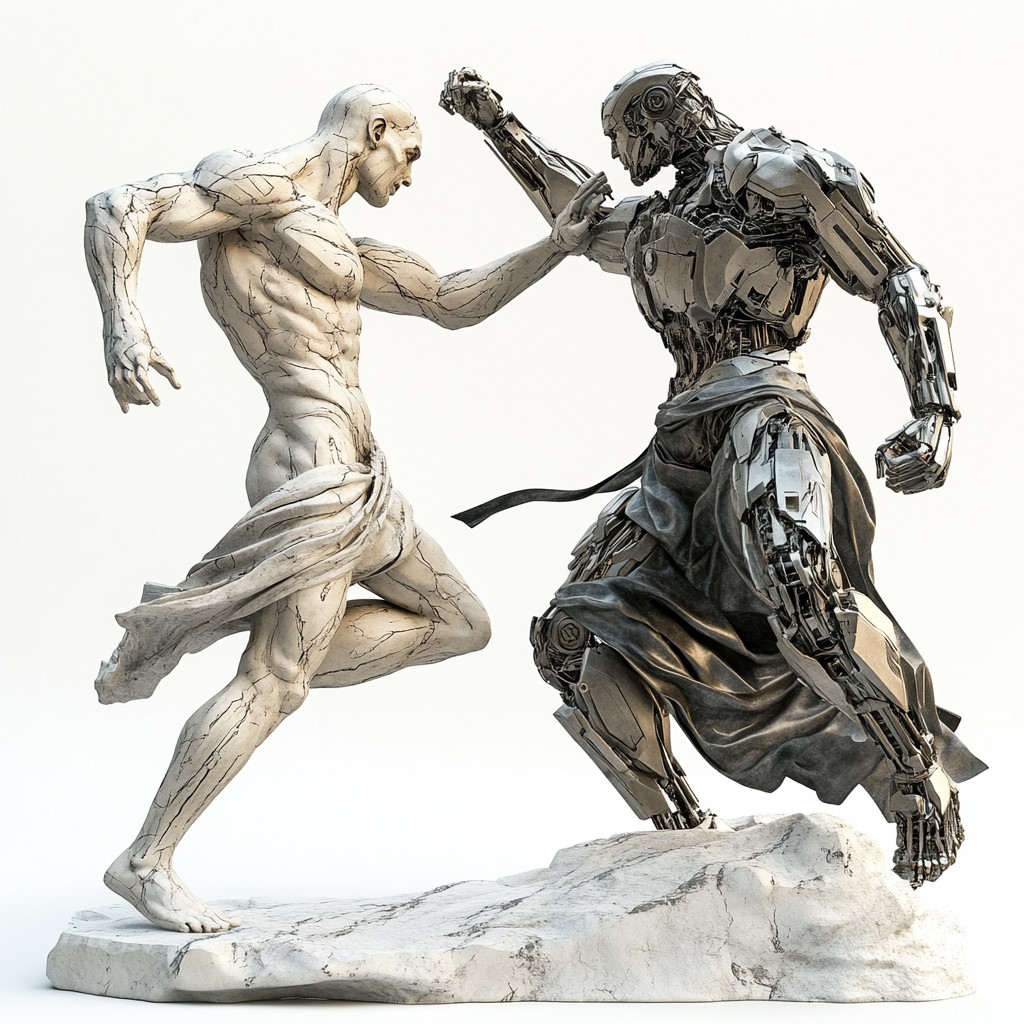
Could it lead to creating an enemy we’ll have to battle one day? (Image: Midjourney)
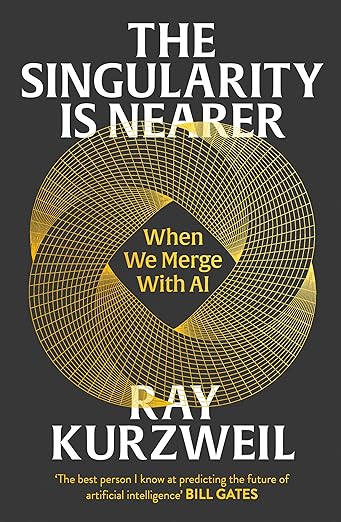
In “Singularity Is Nearer,” Ray Kurzweil envisions technology making us immortal by the end of the 2050s. Hundreds of billions of nanorobots will patrol our bodies to repair cells and kill viruses. Is this just another posthumanism fantasy and longevity utopia? No, it’s misleading nonfiction with cherry-picked arguments.
Science meets speculations
In the 2005 bestseller “The Singularity Is Near,” Kurzweil was quite sure that by 2030, advancements in biotechnology and nanotechnology would significantly increase human lifespans. Gene therapy, stem cell therapy, and modern pharmaceuticals will combat aging and disease, allowing humans to win over mortality.
“The Singularity Is Nearer” does not mean rethinking the 2005 visions. It goes even further in controversial views. Humans will not only soon be beaten in intelligence by AI—which is a plausible scenario—but we will merge with technology, creating a new species.
Even if you intuitively might have some doubts right now, Kurzweil does not leave space for “maybes,” “howevers,” or alternative scenarios. He delivers simple answers to complex questions and a compelling vision of transhumanism. Unlike scientists who use many “mights” to be objective and honest, Kurzweil is self-confident and does not fret over details. No wonder, as a principal researcher and AI visionary at Google, he believes strongly in the superpowers of AI.
With every page, his narrative becomes more extreme, finally confronting us with technocratic statements like, “Freed from the enclosure of our skulls and processing on substrates millions of times faster than biological tissue, our mind will be empowered to grow exponentially, ultimately expanding our intelligence millions-fold.”
Is it still science or already science-fiction?
Questionable argumentation
The chapter “The Next Thirty Years in Health and Well-being” starts softly when Kurzweil zooms in on the success of mRNA vaccines, which saved millions of lives during the COVID-19 pandemic. He mentions real advancements in life sciences, like mRNA cancer vaccines for individualized immunotherapies.
Such leaps in medicine wouldn’t have been possible without AI, and AI is an enabler for many more inventions. The AI system AlphaFold by Google DeepMind predicts the 3D structure of hundreds of millions of proteins from their amino acid sequence. AI is used in drug development, makes human organ simulations possible, and helps understand the brain. AI is making an impact in genetic biology. AI can monitor the spread of infectious diseases and predict the next pandemic.
So much for facts—as soon as Kurzweil starts to look into the future, he cherry-picks arguments to justify his fantasies. For example, he writes about advances in surgical robotics: “For years, robots have been used to assist human doctors, but they are now demonstrating an ability to perform without human participation.” The first rationale for that is the Smart Tissue Autonomous Robot (STAR). In a 2016 experiment, STAR achieved better outcomes than human surgeons at an intestinal stitching task in animal testing. The second argument is a Chinese robot that completed full dental implant surgery independently; the third example is Neuralink.
However, it takes only a short deep dive into these examples to find that in the study “Autonomous robotic laparoscopic surgery for intestinal anastomosis,” the STAR robot is promising but has many technological limitations. Neuralink is not a good case study either: although the first brain-computer interface was implanted into the human brain, in May 2024, the company informed that some of the chip’s wires pulled away, which reduced the implant’s data speeds and effectiveness. And yes – there are already robots assisting in dental implant surgeries. Mind the keyword: assisting.
The optimistic predictions regarding autonomous robots bring to mind the history of autonomous vehicles that started in the 1980s with the Autonomous Land Vehicle (ALV) project by the Defense Advanced Research Projects Agency. It took 25 years for the first autonomous cars to offer rides for people, and assume that the car industry is much less regulated than the healthcare industry. The first surgery da Vinci robot was approved by the FDA in 2000. In 2024, there will be around 7500 robots worldwide, and an estimated 4.5% of all hospitals have Da Vinci. The barrier is the same as almost three decades before—the costs didn’t decrease radically, making the technology more affordable. In the U.S., the da Vinci SP system is approved only for a few procedures, including single-port urological procedures, lateral oropharyngectomy (radical tonsillectomy), and tongue base resection.
Fixing humans like cars
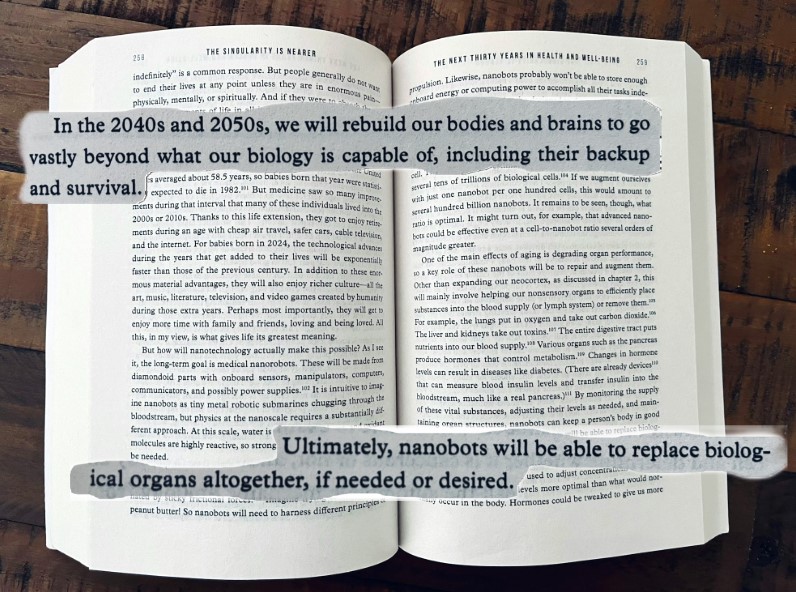
Ignoring legislation, ethical issues, and other adoption barriers, it’s easy to demonstrate the exponential growth of any technology. This is also the case with nanotechnology in healthcare—one of the most controversial chapters in the book. Kurzweil claims that “The 2030s will usher in the third phase of life extension, which will be to use nanotechnology to overcome the limitations of our biology altogether […] In the 2040s and 2050s, we will rebuild our bodies and brains to go vastly beyond what our biology is capable of, including their backup and survival.” How? By using nanorobots to repair our aging cells.
Let’s do some math. If the human body is built of around 36 trillion cells, and one nanorobot is required to care for 1000 cells, a total of 370 billion robots—made of diamondoid parts and armed with sensors, nano-computers, communication systems, and batteries—would be required to keep us alive forever. Don’t worry: assuming that the diameter of a nanorobot is about 0.5 to 3 microns, it’s just one teaspoon or medical syringe.
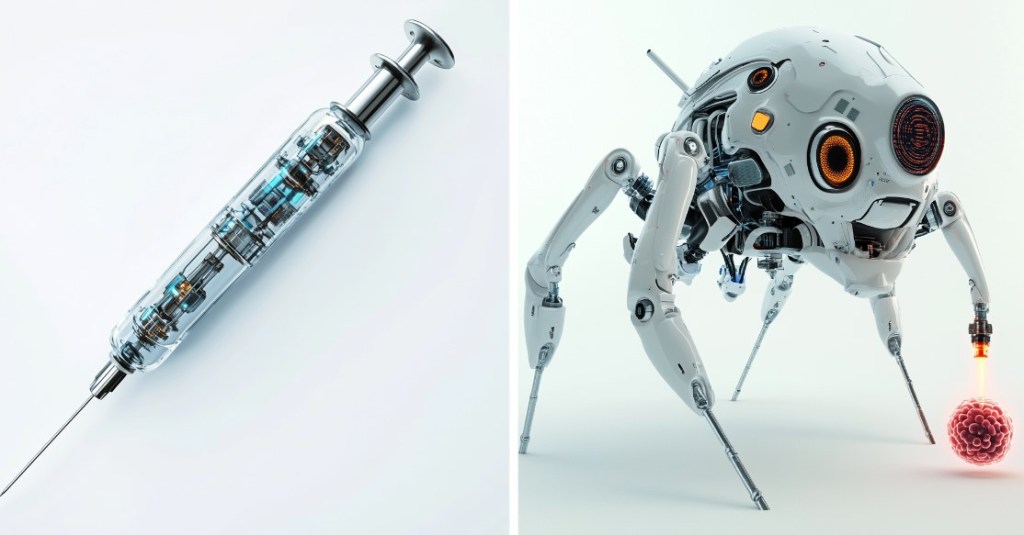
They could also regulate hormones, destroy cancer cells, and kill viruses. They could even replace blood supply or biological organs. Finally, our brains will eventually “become more than 99.9 percent nonbiological.” Here starts the longevity part of the book. Kurzweil cites the longevity guru Aubrey de Grey, who said that the first person to live 1,000 years has likely been born.
You might ask: “What will I do with these 1,000 years?” “Will I still get my pension to spend the rest of my 900 years enjoying life?” or “Will I be like a zombie?”. Kurzweil offers a simple reasoning again. Life won’t be boring since our brains will be augmented with AI. Having just a normal brain means you can, at most, travel, go to the theater, meet friends, or watch TV. With an extended brain, you will delve into the metaverse, travel in time, and experience things that real life can’t offer.
Even as a technology enthusiast, I have some doubts. So I asked Professor of Biology Robert A. Weinberg, Director of the MIT Ludwig Center for Molecular Oncology, if this scenario is possible. His answer was straightforward: “The issue is not repairing individual cells but regenerating the tissue as a whole. At present, there is no prospect that nanorobots will be able to repair individual cells.” Like every good scientist, Professor Weinberg adds that we don’t know what the future will bring.
“Repairing human cells” might sound reasonable until we consider what “repairing” entails. First, scientists must identify all the cellular hallmarks of aging. We are making slow progress in understanding the mechanisms of aging, which involve many complex processes, such as telomere shortening, altered intercellular communication, and mitochondrial dysfunction. There is no quick fix for halting the processes behind aging, and the technology of fancy nanorobots seems to be the easiest part of this endeavor.
Nanorobotics is not a science fiction, though
The research on nanorobots is at a very early stage. Even if the tech will be ready one day, imagine the time required for the first clinical studies on humans to verify worst-case scenarios. What if a nanorobot breaks down or makes a mistake? Without fully understanding the complexity of human cells—which can still take decades—no technology can repair them. And who would control hundreds of billions of miniaturized robots injected into our bodies that are able to self-replicate?
As a layman in nanotechnology, I wrote an email to Peer Fischer, a German robotics researcher, Professor of Experimental Physics, and head of the Micro, Nano, and Molecular Systems Lab at the Max Planck Institute for Medical Research in Heidelberg. Here is what the expert in nanorobotics answered:
“Currently, it is certainly unclear how one could integrate sensors, manipulators, computers, communicators, and possibly power supplies on the scale of a single cell. However, since the envisioned ‘robot’ is on the length scale of a human cell, I would call it a microrobot and not a nanorobot. Without being able to implement anything biologically meaningful, a structure containing sensors, manipulators, a digital circuit, and antennas would be feasible today on the scale of a few hundred micrometers.
Regarding biological and medical benefits, systems based more on biological mechanisms and molecules seem more realistic than entirely synthetic systems with ‘miniaturized batteries’ and ‘computers.’
According to Professor Fischer, the biggest hurdles are perhaps less technical and more related to the extent to which biology can be understood and influenced so that such a complex intervention that dramatically prolongs life can be implemented meaningfully. We must consider the wear and tear of all tissues in the human body—all materials and structures in the body would have to be replaced if life is to be extended dramatically.”
Technological determinism
I skip the ethical questions since ethics are not set in stone. It’s too easy to criticize theoretical concepts of immortality, given that extending life to 1,000 years is impossible. I also won’t address the danger of a two-class society with rich immortals and poor mortals—we already have significant societal and economic gaps. I do not ask who we will be when merging with machines. These issues are debatable and still theoretical. And finally, I do not argue with those striving to prolong life at any price. For millennia, death has been seen by many as an enemy rather than a part of life, taking from us those we love too quickly.
However, I’m critical of posthumanism with an apocalyptic touch without alternatives. It’s like our lives in the future will be determined by technology, not the other way around. In Kurzweil’s book, people are reduced to objects of AI advancements.
The perils of all the technologies have been reduced to 19 pages in the 292-page book. Out-of-control self-replicating nanobots could eat the Earth to further replicate in three hours. Some other “side effects” include bioterrorism or superintelligent AI eliminating people as soon as it realizes that people want to turn it off.
What I also find questionable is how “Singularity in Nearer” gives the impression of being a well-researched scientific book. But it’s not. It’s a tip-of-the-nose perspective that verges on misinformation.
Dreaming big is so human
Kurzweil, the principal researcher and AI visionary at Google is a beloved tech prophet for a reason. Some of his visions from his 2005 biggest bestseller, “The Singularity Is Near,” proved accurate. Since the premiere of ChatGPT, we have realized AI’s rising capabilities and started to consider that AI would reach human-level intelligence by 2029. It is still realistic that autonomous cars will be widespread by the end of the present decade, but it is not granted. Take a look at Tesla, which has been scaling steadily from 75 900 cars delivered worldwide in 2016 to 1 808 590 in 2023. However, the Q1 2024 sales broke the 7-year trend or record-breaking growth. Geopolitics, politics, and consumer expectations matter, no matter how great the technology is.
However, Kurzweil was also often wrong when he wrote that in 2020, robots would begin to accompany people and integrate into everyday life. It doesn’t matter that he erred since the predictions are not about accurate super-forecasting but about anticipating the uncertain future. We like to hear inspiring stories that release emotions like hope and fear.
In 1988, Apple shared a vision of healthcare in 20 years. It predicted telemedicine, wearables, AI-based decision-support systems, AI bots assisting patients and doctors, electronic medical records without typing, and evidence-based medicine. Thirty-five years later, the technology is almost there, but its implementation lags.
In 1955, an Arkansas physician claimed that by 1999, the lifespan would reach 150 years, infectious disease would be a matter of the past, and cancer would be “successfully treated by a virus vaccine or radioactive compounds.” Who wouldn’t like that to be true? Unfortunately, the future is never linear.
Even the smartest nanorobots will one day face the healthcare system with its regulation, static business models, and culture. I can’t imagine injecting myself with invisible robots that can replicate in my body like viruses. There are so many things that could go wrong that Kurzweil—who looks through the technocratic lens while ignoring the complexity of medicine—doesn’t see. Despite all the most remarkable innovations, people still need a doctor who will give some hope or hold a hand when things seem hopeless. Nanorobots can’t do that.
Reading “The Singularity Is Near,” it’s hard not to draw parallels with movies where robots rise against humans: Terminator, The Matrix, Ex Machina, Blade Runner 2049, or Avengers: Age of Ultron, to name a few. It’s a future where humans lose because they don’t care enough about AI governance or ethics, being over-optimistic about technology self-regulation. We made the same mistake 150 years ago during the Industrial Revolution, using the potential of technologies to its limits for economic growth.
“We should thus work toward a world where the powers of AI are broadly distributed so that it reflects the values of humanity as a whole,” concludes Kurzweil. And I finally agree with him.

Can I ask you a favor?
Please donate to aboutDigitalHealth and help sustain this not-for-profit knowledge portal. Thank you!
€1.00
 about Digital Health