
 Posted by
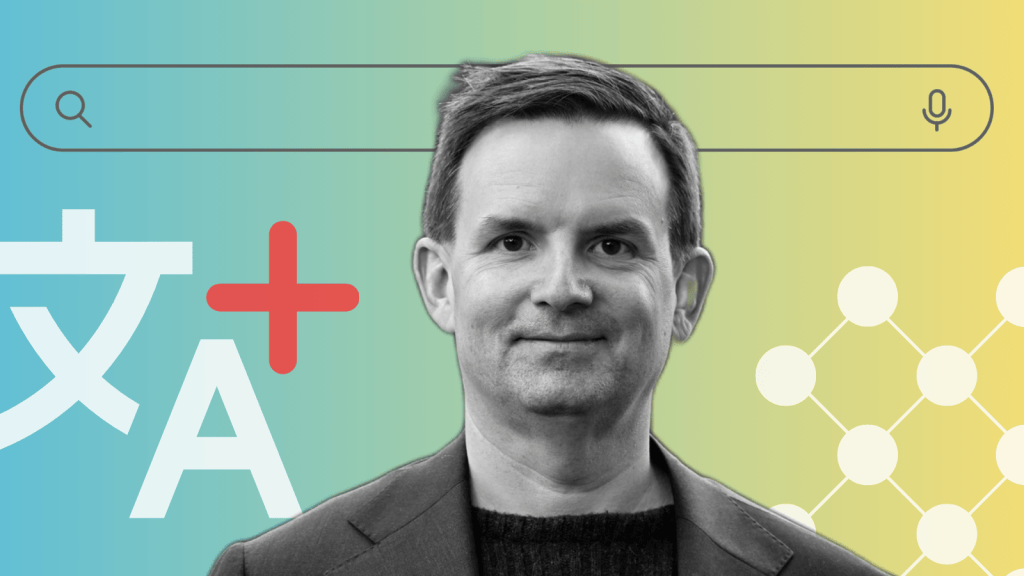
Google answers more than 1 billion health-related search queries a day, but its ambitions go well beyond the Dr. Google cliché. The company conducts clinical research and develops AI models for medical diagnosis. I spoke to Michael Howell, Google’s Chief Health Officer, about the company’s healthcare strategy, its latest AI-powered products, and algorithms designed to answer patients’ most complex questions.
You worked at Harvard Medical School and the University of Chicago. What led you to switch from an academic career to Chief Health Officer at one of the biggest tech companies?
I worked as an intensive care physician for a long time, and I worked on patient safety and healthcare quality. One of the things you learn very quickly in those roles is how important good information is, whether you’re a doctor, a nurse, a patient, a family member.
And the other thing you learn is that it’s better to be upstream – prevention is always better than treatment. Just before I came to Google in 2017, the team had a breakthrough paper about using neural networks to identify one of the leading causes of preventable blindness in the world, diabetic retinopathy.
Today it almost feels commonplace, but then it was a tremendous breakthrough, and I felt like you could begin to see the outlines of how technology might really help in health and healthcare. And that at Google, you could think about how to bring those benefits to everyone, everywhere.
What is it like to work for a company that processes over 1 billion health-related searches every single day?
I wake up every day focused on this. It is an extraordinary privilege and an immense responsibility. People turn to Google in really important moments in their lives, and health is no exception.
We work really hard to meet this responsibility, and we do that in many ways. First, we work on the science. Our teams have more than 300 scientific publications about health and AI, and we’re really transparent in those papers about the methods and where it works and where it doesn’t. Second, we invest deeply in information quality and ensuring we’re connecting people to trusted, reliable information from authoritative sources. Third, we work hard to connect people to real-world support when they need it, whether that’s through Google Maps helping you find pharmacies near you, or our recent integration with Gemini app and Zocdoc, a first-in-kind agentic healthcare appointment scheduling integration.
Google’s strategy in health spans consumer devices, Gemini, clinical AI, open models such as MedGemma, tools for national health systems and Care Studio for EHR summaries. Is there a common thread that connects all these solutions?
Yes, absolutely. Google’s mission in health is simple: billions of healthier people. We want to help everyone, everywhere live a longer, healthier life.
We organize this work around a few core pillars. First is empowering the individual and meeting people where they are – putting agency and anticipatory health insights directly into people’s hands through tools they rely on daily, like Search, YouTube and Gemini, as well as sensors that let people understand their own health like never before, with Pixel Watch and Fitbit, supported by personalized coaching in the Google Health app.
Second is enabling the broader healthcare ecosystem; we believe that many hands make light work. We do not deliver clinical care or manufacture pharmaceuticals ourselves; instead, we provide the open models, secure cloud infrastructure, and AI platforms that allow health systems, academic researchers, and biotech pioneers to innovate and solve problems.
Third is building the world’s best AI, and bringing that to health and healthcare. Gemini is multimodal (text, images, audio) and built to handle the complexity of biology. We believe that to be bold in the long term, we must be responsible from the start. In health, AI isn’t just about code; it’s about care. We don’t just build models; we build evidence.
Before the generative AI revolution, Google redirected people seeking health advice to the most relevant, trustworthy sources. Now AI summaries deliver direct recommendations. How has the precision of the answers changed since the first AI summaries and the launch of Gemini?
Search today helps people find great sites across the web. As part of this, AI Overviews and AI Mode really focus on citing high-quality, authoritative sources, and they’re rooted in our core Search ranking systems.
For example, today when I asked “what are the signs of diabetes?” the sources I got cited were CDC, Mayo Clinic, and Diabetes UK. This is one of the benefits of Search – we have decades of experience with identifying high-quality sources. AI enables us to help with more nuanced questions, and people have really seen the benefit of that – queries in AI mode are on average three times longer than they were before.
Gemini-powered Health Coach delivers fitness, sleep, and health guidance. As a wellness, rather than a medical, solution, it has some limitations. Will you stay in fitness tracking, or do you want to enter medical-grade algorithms?
We are fully committed to both fields. Connected wearables represent a vital entry point for supporting individuals, allowing us to go beyond simple step-counting and wellness tracking to provide both everyday guidance and life-saving, medical-grade capabilities.
We’ve had regulated medical features on the Pixel Watch and Fitbit for a number of years – for example, ECG and irregular rhythm notifications. We’ve also focused on safety, and we have some unique, first-of-their-kind features, such as Loss of Pulse detection and, in Europe, breathing emergency detection. These will call emergency services when they detect that a customer remains unresponsive after one of these potential emergencies.
We also have great fitness, wellness-tracking and coaching capabilities. For instance, the Personal Health Coach powered by Gemini – available in select global markets – provides personalized, science-backed lifestyle and wellness guidance.
One of the more serious solutions recently launched is Health Guardian on Pixel Watch, with features for tracking insulin resistance, blood pressure and sleep emergencies. How does Google develop such powerful solutions before they are released to customers?
As you can read in our launch blog, every Health Guardian feature has undergone thoughtful clinical validation with gold-standard ground truth devices and measurement protocol, incorporating feedback from the scientific community. We’ve worked hard to help build the evidence base in this field, including with peer-reviewed science. For example:
- Insulin resistance trends are built with our latest large sensor foundational model, which is pretrained on over one trillion minutes of data from 5 million opted-in users. An article speaking to their accuracy, which was validated by standard clinical blood tests, was published in Nature.
- Blood pressure trends are built on WavesFM, a foundation model trained on billions of minutes of raw heart and movement data. The data was validated across a diverse range of people and by a Fitbit Hypertension Labs study.
AMIE made the headlines by showing how a multimodal AI can conduct medical consultations. Is AMIE ready for clinicians to use?
AMIE – our research project for AI in clinical reasoning – recently reached a major milestone with a study in The Lancet. This study addressed an important question: can diagnostic AI safely interact with real patients in an active primary care clinic? Up to this point, much of the research on conversational diagnostic AI – including our prior AMIE work – has relied on simulated environments (like Objective Structured Clinical Exams (OSCEs), with patient-actors). As clinicians, we know OSCEs are a fantastic, safe testing harness. But simulation isn’t clinical care.
Partnering with Beth Israel Deaconess Medical Center, our researchers assessed AMIE across 100 pre-visit urgent care consultations under live clinician supervision with zero safety stops required, demonstrating strong conversational safety, and clinicians reported that the AI summaries helped them prepare for visits in 75% of cases and influenced their approach to care in more than half.
Our research has demonstrated that conversational AI can achieve impressive diagnostic accuracy and empathetic communication in simulated and real-world clinical settings.
AMIE is still an early experiment; it’s not ready for larger-scale deployment. Our latest research gives us a really exciting look at how AI could work incredibly well as a partner to both doctors and patients.
AI is already being used in public health to predict specific health risks. What role do you see for AI at the population-health level?
AI has an immense role to play at the population-health level, particularly in scaling risk prediction, preventative care, and public health education. We see AI acting as an accelerator across several dimensions (read the blog post for more details). We’ve seen how AI is helping people understand and improve health not just one visit at a time, but for populations – in conditions as diverse as cardiovascular disease, diabetes, dengue, and Ebola.
Are there any health-related solutions Google offers that aren’t as well-known as its core products but are worth checking out for individuals, clinicians, or researchers?
We don’t just build models, we build evidence. We prioritize rigorous clinical validation and peer-reviewed research. We’ve been doing so for a decade.
For example, our teams had one of the foundational papers about AI detecting one of the most common causes of preventable blindness, all the way back in 2016. Today, our Articulate Medical Intelligence Explorer (AMIE) system is being actively evaluated along multiple dimensions that reflect quality in real-world clinical consultations.
We are also publishing state-of-the-art research benchmarks and open-sourcing tools to encourage collaborative evaluation. We must build a strong evidence base to understand exactly where AI works and where it doesn’t.
What book has inspired you most recently on AI in healthcare?
I had the pleasure of interviewing Bob Wachter recently at Talks at Google. I have known Bob for nearly 10 years, and his work for much longer. His new book, “A Giant Leap,” is quite good and optimistic (you can watch the interview here).
One of the things I like about it is that he is optimistic about the current moment and the impact that AI can have on health. If you read some of his prior works, he didn’t have the same degree of optimism.
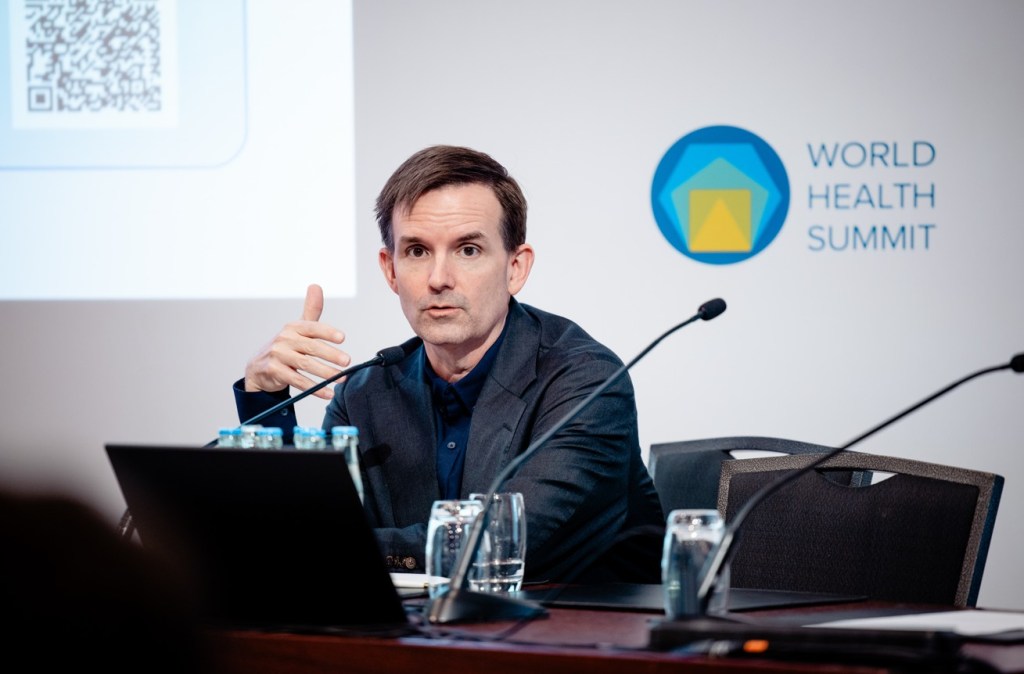
People’s health questions are getting nuanced. Michael Howell at the World Health Summit.
Google receives more than a billion health-related questions on Google Search every day. On average, 15 percent of what people ask Google each day has never been asked before in human history. That might sound impossible, but language is an extraordinarily high-dimensional space.
People’s real questions about their health are nuanced, personal, and highly localized. The ability to answer those questions is one reason I think we’ve seen such significant uptake of AI. It helps answer questions people genuinely have, and it helps them discover the questions they want to ask. People may start with a vague or incomplete health question, and AI can help them clarify their concerns and ask more precise, useful questions
We’ve all had a professor whom we could approach with a question, and who would help us figure out the question we were really trying to ask. We’re seeing evidence that, as people gain experience with AI, they’re able to ask increasingly nuanced questions that we can help them with.
On Search, questions are now three times longer than they were before we introduced AI answers.
Make a one-time donation
Make a monthly donation
Make a yearly donation
Choose an amount
Or enter a custom amount
Your contribution is appreciated.
Your contribution is appreciated.
Your contribution is appreciated.
